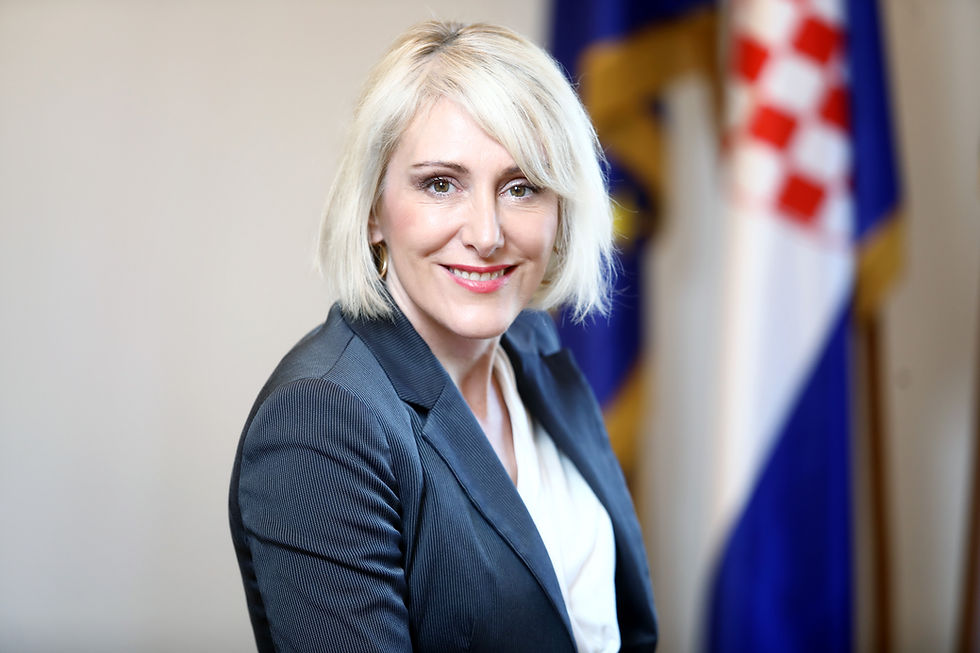
1. Almost a year after your election as EWN Chair: what are the objectives of the Network and next initiatives?
My first year was marked with our survey, which evaluates the state of play of female entrepreneurship from skills to work-life balance, sustainability, and digitalisation to obstacles for women entrepreneurs. The answers in this survey mirror the general trend of enterprises in Europe; Unfortunately, one of the main obstacles faced in running businesses seems to be linked to liquidity problems and access to finance. The survey confirms that we are still facing a gender gap and that in entrepreneurship gender still matters - a significant number of participants answered that they consider it would have been much easier for them to be paid more if they were men; the same applies for professional advancement. Also, we still have an underrepresentation of women in business: the first reason is a male-dominated industry, the second is too little encouragement given to women to take leadership responsibilities, and the third reason is work-life balance challenges. On the other side companies led by women began investments in the sustainable and digital transition earlier.
In the last five years, the biggest rise of women in management positions in the EU is visible in Austria, with a roughly 40% increase; Czechia is second, with an increase of 9%, while Croatia only recorded a 0.7% increase in the number of women in management positions over this period. Here I see room for development so in my activities, through the EWN, I have already started with panels/events to highlight the importance of this issue and through the two recently adopted laws and directives by the European Parliament: about gender representation and the gender pay gap we are promoting role models of businesswomen/women leaders and companies with these goals. My goal is through examples of good practices to spread this influence onto our chamber network. The issue of gender equality and equal pay are values that lead to a better company as well as society.
2. How is the Croatian Economic Chambers supporting women entrepreneurship at local, national and EU level?
The chamber network plays very important role in empowering women entrepreneurship, offering tools that help improve business performance and sustainable economic growth. Chambers encourage the adoption of policies that meet the needs identified by women entrepreneurs. Through our ESG Academy we are preparing our members for non-financing reporting and acknowledgment of the importance of UN goals among which is gender parity. We organize panels/events to highlight the importance of gender parity and equal pay and values for the sustainable development of each sector. In this way we hope to establish more women in management and supervisory board positions, motivate women for higher positions and, by promoting role models, to make these positions more attractive for women.
We have also established a Business start-up incubator for women entrepreneurs with the aim of contributing to the development of women entrepreneurship by supporting women in their first business steps by using equipped offices, by mentoring, advisory and the promotional role of chamber in their first three years in business.
3. According to the Global Gender Gap report, at the current rate of progress, it will take 131 years to reach full parity. Which key topics should governments focus on to tackle the problem?
Women make up half of the EU population, more than half of highly educated persons in the EU and on average, they earn 13% less than men.
Only 8% of women lead Europe’s largest companies. These numbers are impossible to understand nowadays. Somehow, our technological progress left our main participants behind. More than 100 years is a lengthy period, and it demands inclusion of all parts of society in this process. We can’t lean just on legislative foundations or on partly fulfilling quotas…. Quotas should be understood as a means through which we change the structure and values of society and develop cultural standards. This goal needs mainly change of mindset and recognizing the key values of women leaders for a company which are, among the other things, stronger control-monitoring roles, empathy as an instrument for the smoother running of business activities, team players, human resources experts and more independence in the decision-making process.
4. What is, in your opinion, the role that Chambers in Europe could play to better support women entrepreneurship in this transitional phase?
The importance of women as a workforce potential has a strong impact on economic indicators. For example, if women were given equal opportunities, the GDP in the EU could increase to 3.15 trillion euros by 2050 (according to the European Institute for Equality). This shows us the importance of reducing the wage gap, which is now 13% in the EU. In Croatia, it is slightly smaller at 11%. So, women in the EU earn 13% less than men and have 30% lower retirement incomes (pensions). It is also important that about 47% of companies with a share of women on management boards of more than 50% have above-average ESG results. We are a significant number of the workforce, so it is essential to change the way of leadership and to promote the equality of women to men through their tasks, projects, and activities. Although the present situation in the EU is much better (3 EU institutions are led by women), the gap is still visible, and we (the chambers) and the EWN have the leading role in contributing to overcome this gap. How? By promoting, encouraging and more than ever, educating and preparing our members for it. Due to the twin transition and labour shortages we need, more than ever, realize the opportunities for women in developing digital and green skills. By attracting more women into ICT occupations has the potential to both alleviate certain labour shortages in this area and reduce existing gender disparities in use of digital skills at work. Even where women hold relevant qualifications, they have a lower likelihood of progressing into and keeping ICT jobs. This may be linked to certain aspects of employment in ICT, such as: reliance on full-time work patterns that are difficult to reconcile with unpaid care responsibilities; biases in recruitment practices, remuneration (gender pay gap), and promotion ladders; or masculine working cultures that may be particularly difficult for women to work within.